BiPAP Machine Buying Guide: Types, Features & How to Choose in Bangladesh

The Short Answer: How Do You Choose the Right BiPAP Machine?
The right BiPAP machine depends mainly on your prescription (the BiPAP mode your doctor ordered), your condition (sleep apnea, COPD, or another breathing disorder), the features that affect comfort (humidification, noise, mask fit), and reliable after-sales support in Bangladesh. Start with your doctor’s prescription — it determines the BiPAP type — then compare features that directly affect therapy comfort, and buy from Sleep Apnea & Respiratory Care Solutions in Bangladesh you can reach for setup help and servicing.
Quick Buying Summary
Newly diagnosed with sleep apnea and can’t tolerate CPAP → A BiPAP S or Auto BiPAP is the usual starting point; comfort features (humidifier, quiet operation) matter most.
COPD or breathing-muscle weakness → Your doctor will likely prescribe BiPAP ST with a backup rate; prioritise machines with reliable timed-breathing support and data tracking.
Buying for an elderly parent at home → Choose a simple, dependable model with local warranty and a seller who provides setup guidance and mask-fitting help.
Unsure whether BiPAP is even right for you → Get a sleep study first (for example at NIDCH or a sleep clinic), then decide with your physician — never buy on guesswork.
Short-term need (post-surgery recovery) → Consider renting before buying; see the rental option section below.
What Is a BiPAP Machine?
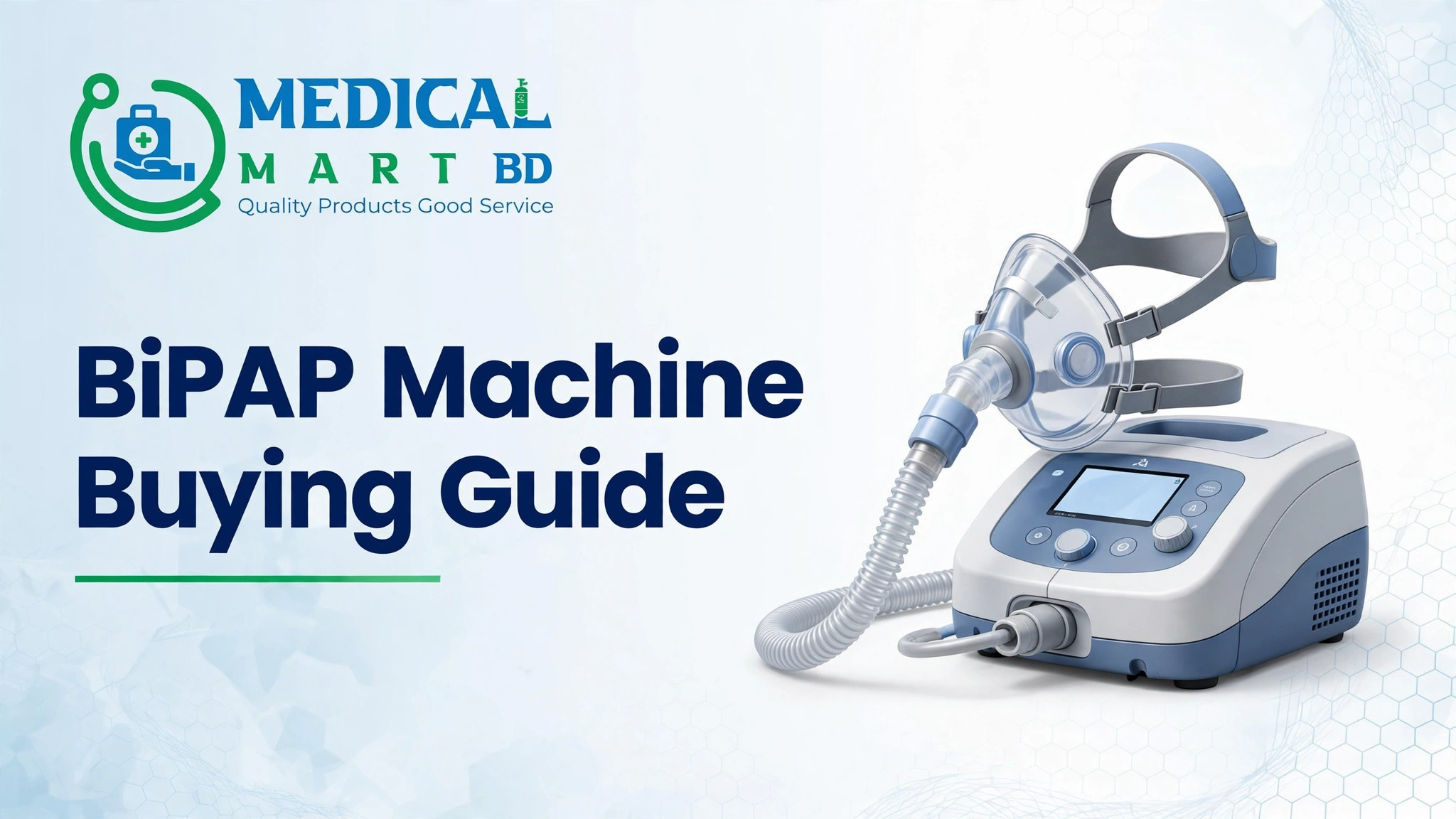
A BiPAP (bilevel positive airway pressure) machine is a non-invasive breathing device that delivers air at two different pressure levels through a mask: a higher pressure when you breathe in (IPAP — inspiratory positive airway pressure) and a lower pressure when you breathe out (EPAP — expiratory positive airway pressure). This two-pressure design keeps the airway open while making exhalation noticeably easier than with a single-pressure CPAP machine.
Doctors prescribe BiPAP therapy for obstructive sleep apnea (especially when a patient cannot tolerate CPAP), central or complex sleep apnea, COPD, obesity hypoventilation syndrome, and neuromuscular conditions that weaken breathing muscles. In plain terms: if breathing out against constant pressure feels uncomfortable, or if a condition requires breathing assistance beyond keeping the airway open, BiPAP is often the answer. For a deeper medical explanation, the Sleep Foundation’s guide on what a BiPAP machine is is a solid reference.
Entity check — Product Category → Product Type → Feature → Use Case → Audience: BiPAP machines (category) come in types like S, ST, and Auto (product types); each offers features such as backup rate or auto-adjusting pressures (features); these serve use cases like COPD support or CPAP-intolerant sleep apnea (use cases); for patients and caregivers in Bangladesh (audience).
Types of BiPAP Machines: S, ST, Auto, and Advanced Modes
Understanding BiPAP types is the single most important part of this buying guide, because the type is usually decided by your prescription — not by preference.
BiPAP S (Spontaneous)
What it is: The machine follows your natural breathing rhythm. It senses when you inhale and switches to the higher IPAP pressure, then drops to EPAP when you exhale. It never forces a breath.
Best for: Sleep apnea patients who cannot tolerate CPAP’s constant pressure but breathe reliably on their own.
Advantages: Most natural breathing feel; usually the simplest BiPAP type to adapt to; often the most affordable BiPAP option.
Limitations: No safety net — if you stop breathing (central apneas), the machine won’t breathe for you.
Who should consider it: Patients whose main problem is comfort with CPAP, with no significant central apneas on their sleep study.
BiPAP ST (Spontaneous/Timed)
What it is: Works like BiPAP S most of the time, but adds a backup rate: if you don’t take a breath within a set time window, the machine delivers a timed breath for you — functioning a little like a ventilator.
Best for: COPD, neuromuscular disorders, obesity hypoventilation syndrome, and central/complex sleep apnea.
Advantages: Safety net for people whose breathing drive is weak or irregular; the two most commonly stocked BiPAP types in Bangladesh (for example the BMC G2S B25VT BiPAP machine and the ResMed Lumis 150 ST) are ST models.
Limitations: More complex settings (backup rate, Ti control) that must be set by a clinician; typically costs more than BiPAP S.
Who should consider it: Anyone whose doctor specifically wrote “ST” or “backup rate” on the prescription.
Auto BiPAP (Auto-Bilevel)
What it is: Instead of fixed IPAP/EPAP numbers, the clinician sets a pressure range, and the machine automatically adjusts both pressures through the night based on your breathing.
Best for: Patients whose pressure needs change with sleep position, sleep stage, or night-to-night variation.
Advantages: More “set and forget” — adapts without manual retitration; can improve comfort for people with variable needs.
Limitations: Not suitable for every condition (some COPD protocols need fixed ST settings); auto algorithms differ between brands, so clinician familiarity matters.
Who should consider it: Sleep apnea patients with variable pressure needs who want maximum automation.
ASV and AVAPS (Advanced Modes)
What they are: Adaptive servo-ventilation (ASV) continuously adjusts pressure support to stabilise breathing in central/complex sleep apnea; average volume-assured pressure support (AVAPS) targets a consistent tidal volume and is used in chronic respiratory failure.
Best for: Specific, complex diagnoses — prescribed only after specialist evaluation.
Important: These are specialist devices, not general-purpose BiPAP machines. If your prescription mentions ASV or AVAPS, work directly with your sleep physician and a supplier experienced with these modes.
BiPAP Comparison Table
| Type | Best For | Key Advantage | Limitation | Important Consideration |
|---|---|---|---|---|
| BiPAP S | CPAP-intolerant sleep apnea, reliable spontaneous breathing | Most natural feel, simplest to use | No backup if breathing pauses | Confirm your sleep study shows no significant central apneas |
| BiPAP ST | COPD, neuromuscular disease, central/complex apnea | Backup rate breathes for you when needed | Needs clinician-set parameters | Match the prescription exactly — ST settings are medical decisions |
| Auto BiPAP | Variable pressure needs, position-dependent apnea | Self-adjusts through the night | Not ideal for all COPD protocols | Ask whether your doctor wants fixed or auto pressures |
| ASV / AVAPS | Complex central apnea, chronic respiratory failure | Advanced stabilisation of breathing | Specialist-only, higher cost | Buy only under direct specialist supervision |
Key Buying Factors: What to Check Before You Buy
1. Prescription and BiPAP Mode
Why it matters: A BiPAP machine is prescription medical equipment. The mode (S, ST, Auto) determines which machine you need — buying the wrong type wastes money and can deliver ineffective therapy.
What to look for: A written prescription or sleep-study report naming the mode and pressure settings. Reputable medical equipment suppliers in bangladesh will ask for it before recommending a model.
Who needs it: Everyone. No exceptions.
2. Pressure Range and Settings Flexibility
Why it matters: BiPAP machines typically operate across a range of about 4–30 cm H₂O. The machine must cover your prescribed IPAP/EPAP comfortably, with room for future adjustment.
What to look for: Confirmation that your prescribed pressures fall well within the machine’s range; clinician access to fine-tuning (rise time, trigger sensitivity).
Who needs it: Patients with high pressure needs or conditions likely to progress (e.g., COPD).
3. Backup Rate (for ST Users)
Why it matters: The backup rate is the safety net that defines BiPAP ST — it guarantees a minimum number of breaths per minute.
What to look for: Adjustable backup rate and inspiratory time (Ti) settings; ask the seller to demonstrate how they are set.
Who needs it: COPD, neuromuscular, and central-apnea patients — anyone prescribed ST.
4. Heated Humidification
Why it matters: Pressurised air dries the nose and throat. In Bangladesh’s dusty dry season, dryness is one of the top reasons people abandon therapy.
What to look for: Integrated heated humidifier with adjustable levels; heated tubing option if available.
Who needs it: Almost everyone — especially mouth breathers and dry-season users.
5. Data Tracking and Reporting
Why it matters: Modern BiPAP machines record usage hours, leak, AHI, and pressure data. Your doctor uses these reports to fine-tune therapy at follow-ups.
What to look for: On-screen sleep reports plus app/SD-card data your clinician can actually read.
Who needs it: Anyone under active medical follow-up — which should be everyone.
6. Mask Compatibility and Fit
Why it matters: The best machine fails with a leaking mask. Mask type (nasal, nasal pillow, full face) affects comfort more than any machine feature.
What to look for: Standard 22mm hose compatibility so you can choose among mask brands; a seller who helps with fitting. Browse compatible options in the CPAP and BiPAP mask collection.
Who needs it: First-time users especially — budget for a proper fitting session, not just the machine.
7. Noise Level
Why it matters: The machine sits beside your bed all night. Excess noise disturbs both the patient and their partner.
What to look for: Ask for a live demo and listen yourself; place the machine below bed level on a soft surface. Don’t rely on brochure numbers alone.
Who needs it: Light sleepers and anyone sharing a bedroom.
8. Power, Portability, and Bangladesh’s Reality
Why it matters: Load-shedding and travel are facts of life. A machine that dies mid-night interrupts therapy.
What to look for: Standard 220V operation; ask about battery backup options for areas with frequent outages; check weight if the patient travels.
Who needs it: Users outside central Dhaka, frequent travellers, and anyone in load-shedding-prone areas.
9. Warranty and After-Sales Support
Why it matters: A BiPAP machine is a multi-year investment. Grey-market imports with no local warranty leave you stranded when something fails.
What to look for: Written warranty terms, availability of servicing and spare parts (filters, tubes, masks) in Bangladesh, and setup guidance — pressure settings explained, mask fitting, humidifier setup. This is where buying from an established local supplier matters more than saving a small amount upfront.
Who needs it: Everyone — but especially first-time buyers and elderly patients’ families.
Choose by Use Case
Best for sleep apnea patients switching from CPAP → BiPAP S or Auto BiPAP. Your need is comfort: prioritise humidification, quiet operation, and data tracking so your doctor can confirm the switch worked.
Best for COPD → BiPAP ST with backup rate, as prescribed. Prioritise reliable timed-breathing support, easy-to-read data reports for your pulmonologist, and a supplier who understands COPD follow-up.
Best for neuromuscular conditions → BiPAP ST (or AVAPS if prescribed). Prioritise precise clinician settings, backup-rate reliability, and long-term service support.
Best for elderly parents at home → Simplicity and support beat extra features. Choose a dependable ST or S model from a seller who will visit or video-call for setup, and keep the humidifier filled — caregivers should learn the cleaning routine.
Best for short-term or uncertain needs → Don’t buy yet. Renting a BiPAP machine in Dhaka lets you trial therapy (or cover post-surgery recovery) before committing to a purchase.
Price and Budget: What Influences BiPAP Cost?
This guide focuses on selection; detailed price tiers are covered in our companion BiPAP price guide. What you should know here: BiPAP machines cost more than CPAP machines because of the dual-pressure system and (in ST models) the backup-rate technology. Within BiPAP, price generally rises from S → Auto → ST → advanced modes (ASV/AVAPS), and brand, humidifier integration, and data features also move the price.
Because prices shift with import costs and availability, we don’t publish fixed figures here — contact Medical Mart BD for current pricing on specific models. Never choose by price alone: an inexpensive machine of the wrong type is the most expensive mistake in this category.
Common Buying Mistakes
Mistake: Buying without a prescription.
Why it matters: Wrong mode or wrong pressures can make therapy ineffective — or harmful.
Better decision: Get a sleep study and a written prescription first. No reputable seller should sell you a BiPAP without asking about it.
Mistake: Choosing BiPAP S when the prescription says ST.
Why it matters: Without a backup rate, central apneas and weak breathing drive go unsupported.
Better decision: Match the machine type to the prescription letter-for-letter. When in doubt, ask your doctor — not the salesperson.
Mistake: Ignoring the mask.
Why it matters: Mask leak is the number-one reason therapy fails, regardless of machine quality.
Better decision: Budget time and money for a proper mask fitting alongside the machine purchase.
Mistake: Buying grey-market for a small saving.
Why it matters: No local warranty, no servicing, no spare filters — and no one to call at 11pm when the machine alarms.
Better decision: Buy from a supplier with a Dhaka presence, written warranty, and after-sales support.
Mistake: Skipping the humidifier to save money.
Why it matters: Dryness and nasal congestion drive more therapy dropouts than any other comfort issue.
Better decision: Treat heated humidification as essential, not optional.
Mistake: Assuming “BiPAP” alone is enough information.
Why it matters: S, ST, Auto, and ASV are genuinely different therapies. A vague purchase risks a mismatch.
Better decision: Learn the types (this guide), then confirm your type with your doctor before paying.
Practical Tips
A few things worth knowing from the buying process itself: always ask for a live demonstration before purchase — you should hear the machine, feel the pressure transition, and see the humidifier and data screens. Ask the seller to explain, in plain language, what each of your prescribed settings does. Keep your prescription and sleep-study report filed with the warranty papers; you’ll need them for follow-ups and filter replacements. And confirm spare-part availability (filters, tubes, masks) before you buy — a machine you can’t maintain is a machine you’ll abandon.
Frequently Asked Questions
Who needs a BiPAP machine instead of a CPAP machine?
BiPAP is typically prescribed when CPAP hasn’t worked or isn’t tolerated — for example, difficulty exhaling against continuous pressure — or for conditions like COPD, central sleep apnea, obesity hypoventilation syndrome, and neuromuscular disorders. The decision always comes from a sleep study and a physician, not from preference.
What is the difference between BiPAP S and BiPAP ST?
BiPAP S follows your natural breathing and never forces a breath. BiPAP ST does the same but adds a backup rate: if you don’t breathe within a set time, it delivers a timed breath. ST is the safer choice when breathing drive is weak or irregular, which is why doctors prescribe it for COPD and central apneas.
Can I use a BiPAP machine without a sleep study?
You shouldn’t. Pressure settings, BiPAP mode, and backup-rate parameters must be determined from a sleep study (polysomnography) and set by a clinician. Using wrong settings can be ineffective or harmful. In Dhaka, sleep studies are available at NIDCH and private sleep clinics.
How long does a BiPAP machine last?
With regular filter changes, proper cleaning, and humidifier care, a quality BiPAP machine typically serves for several years. Longevity depends heavily on maintenance and power conditions — which is another reason local after-sales support matters.
Is BiPAP therapy noisy? Will it disturb my partner?
Modern BiPAP machines are designed for bedside use and are generally quiet, but noise varies by model and mask leak (leaks are often louder than the machine). Ask for a live demo before buying, and fix mask leaks promptly — they’re the most common noise source.
Do I need a special mask for BiPAP?
Not necessarily special, but the mask must suit your pressure levels and breathing pattern. Full-face masks are common at higher pressures; nasal masks or pillows work for many others. Whatever you choose, get it fitted — compatibility with standard hoses means you can try options from the mask range until one seals comfortably.
Where can I buy a BiPAP machine in Bangladesh with warranty?
Buy from an established local supplier that provides written warranty, setup guidance, and spare parts. You can browse the BiPAP machine category to see available models, or read our CPAP & BiPAP hub for an overview of both therapies. For an independent medical perspective on the two therapies, the American Association of Sleep Technologists explains BiPAP vs CPAP therapy in detail.
Finding the Right BiPAP for You
Choosing a BiPAP machine comes down to three steps: get the right diagnosis and prescription, understand which BiPAP type matches it, and buy from a supplier who’ll support you long after delivery. If you’ve worked through this guide, you now know the difference between S, ST, Auto, and advanced modes — and which questions to ask before you pay.
Ready for the next step? Explore the BiPAP machine collection to compare current models, or talk to the Medical Mart BD team at the Mohakhali showroom for prescription-based guidance, live demos, and setup support — with nationwide delivery across Bangladesh.