Auto CPAP vs Travel CPAP Machine in Bangladesh: Which One Should You Buy?

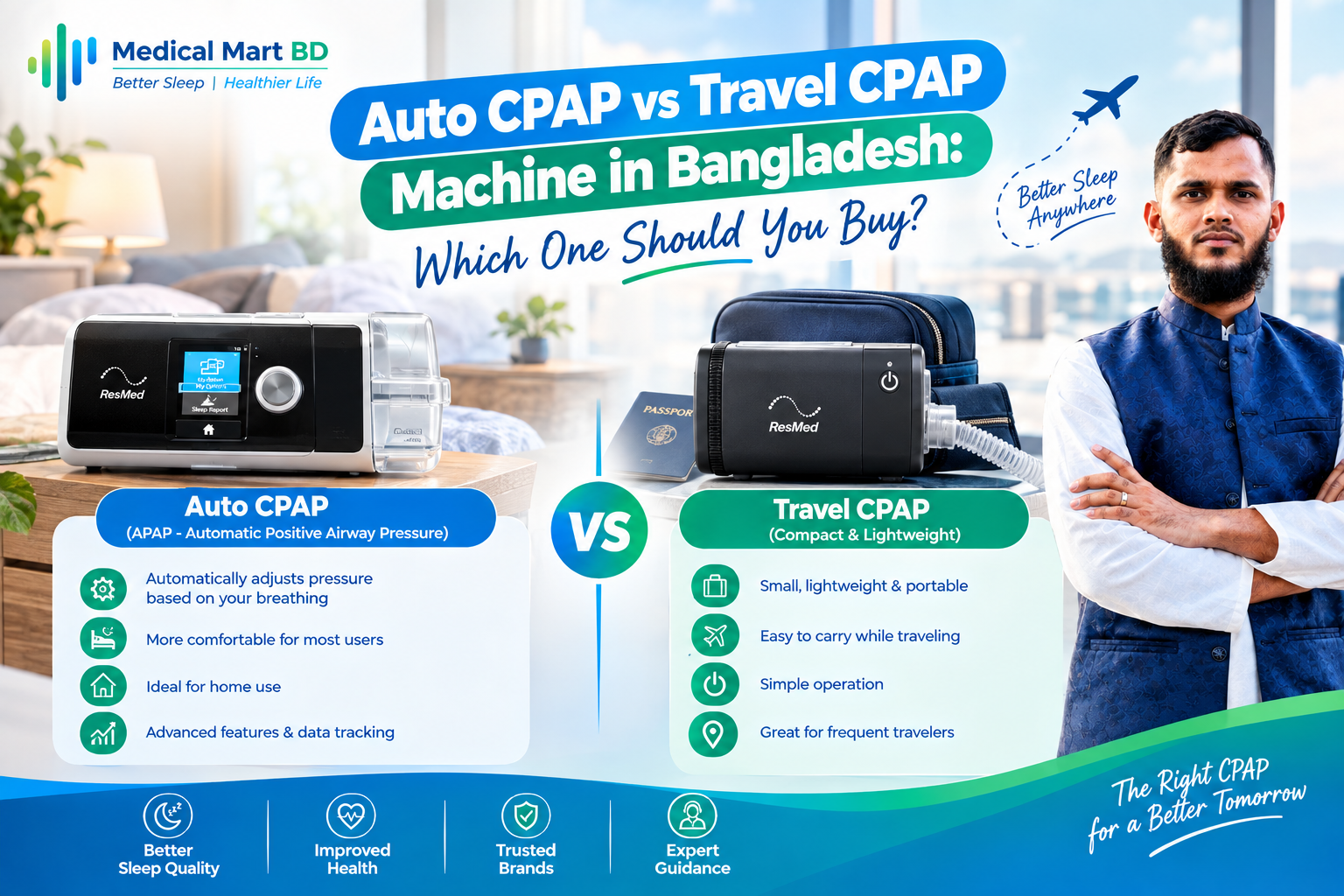
If you sleep only at home and want the machine to adjust pressure automatically throughout the night, an Auto CPAP (APAP) like the ResMed AirSense 10/11 AutoSet or BMC G3 is the standard choice. If you travel frequently — for work, hajj/umrah, or visiting family in other districts — and don’t want to carry a full-size machine, a Travel CPAP like the ResMed AirMini or BMC M1 Mini is built for that.
Here’s the part most comparisons get wrong: “Auto” and “Travel” aren’t opposite categories. Auto CPAP refers to how the machine delivers pressure (it self-adjusts based on your breathing, instead of running a fixed pressure all night). Travel CPAP refers to the machine’s physical size and portability. Many travel CPAP machines — including the AirMini, BMC M1 Mini, and Breas Z1 — are themselves Auto CPAP machines. So the real decision usually isn’t “Auto vs Travel.” It’s “full-size Auto CPAP vs compact Auto CPAP” — and how often you actually travel.
What Is an Auto CPAP (APAP) Machine?
An Auto CPAP machine — also called APAP (Automatic Positive Airway Pressure) — continuously monitors your breathing pattern and adjusts air pressure in real time throughout the night. Instead of one fixed pressure setting all night (like a standard/fixed CPAP), it increases pressure when it detects resistance or apnea events and lowers it when your airway is open.
Most modern CPAP machines sold today — including standard home units — use this auto-adjusting algorithm. That’s why the ResMed AirSense 10 AutoSet, ResMed AirSense 11 AutoSet, and BMC G3 are all technically “Auto CPAP” machines even though they’re full-size, home-based devices with a built-in heated humidifier.

What Is a Travel CPAP Machine?
A Travel CPAP is built for portability first. Compared to a standard machine (roughly 1.3–1.8 kg with a water tank), travel units typically weigh 200–300 grams, run on rechargeable batteries or USB power banks, and often skip the traditional water humidifier in favor of waterless humidification technology (like ResMed’s HumidX).
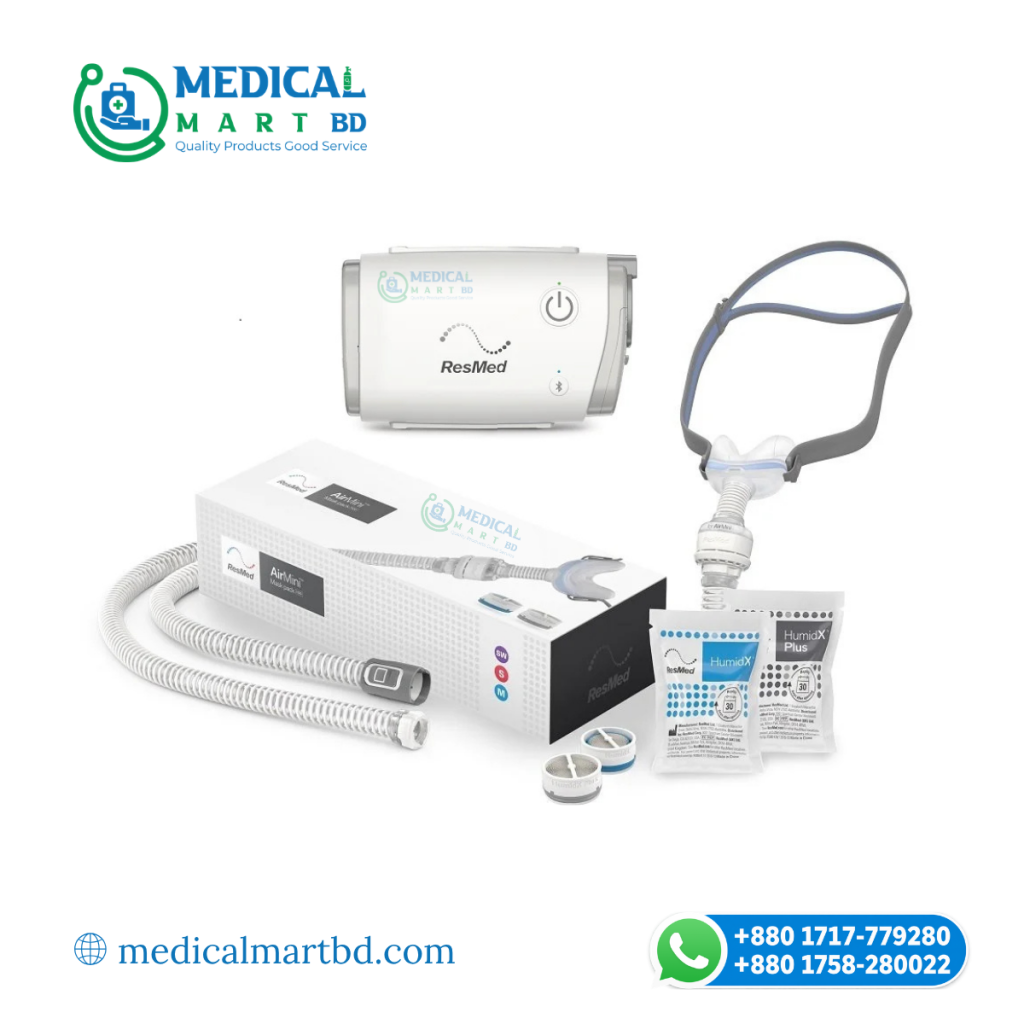
Currently, three models fall in this category:
- ResMed AirMini — the smallest and lightest, waterless HumidX humidification, works with a phone app
- BMC M1 Mini — compact automatic travel CPAP, battery-compatible
- Breas Z1 — auto travel CPAP with more traditional controls and broader mask compatibility
Notice that all three are also Auto CPAP machines by pressure algorithm. That’s the overlap explained above.
Auto CPAP vs Travel CPAP: Key Differences
| Factor | Standard Auto CPAP (Home) | Travel CPAP |
|---|---|---|
| Weight | ~1.3–1.8 kg | ~200–300 g |
| Humidifier | Built-in heated humidifier (water tank) | Usually waterless (e.g., HumidX) or optional |
| Power source | Mains power (AC) | Battery/power bank compatible, plus AC |
| Pressure delivery | Auto-adjusting (APAP) in most current models | Also auto-adjusting in AirMini, M1 Mini, Breas Z1 |
| Noise level | Slightly quieter, larger motor housing | Comparable, sometimes marginally louder |
| Data tracking | Full app + cloud data (ResMed AirView, etc.) | App-based, sometimes phone-dependent (AirMini) |
| Mask compatibility | Wide — works with nearly all standard masks | Often needs specific tubing/mask setup |
| Typical use case | Nightly home use | Travel, hajj/umrah, frequent outstation work, backup machine |
| Price in BD | ৳45,000 – ৳150,000 | ৳80,000 – ৳148,000 |
Is a Travel CPAP as Good as a Regular (Home) CPAP?
For therapy effectiveness, yes — if it’s an auto-adjusting travel unit like the AirMini, M1 Mini, or Breas Z1, the pressure delivery quality is comparable to a full-size Auto CPAP. What differs is comfort features: most travel units have less humidification power (important in Bangladesh’s dry winter months in Dhaka, Rajshahi, or Rangpur), a smaller display for adjusting settings, and in some cases, dependence on a smartphone app to change settings (the AirMini has no physical control buttons — everything runs through the ResMed app).
For patients using CPAP as their only everyday-at-home machine, we generally see better long-term comfort with a full-size unit because of the stronger humidification and simpler physical controls. For patients who travel often and need something that fits in a laptop bag, the trade-off is worth it.
Auto CPAP Machine Price in Bangladesh
| Model | Price (BDT) |
|---|---|
| BMC G2S A20 | ৳45,000 |
| ResFree R-20i | ৳75,000 |
| BMC G3 | ৳59,000 |
| ResMed AirSense 10 AutoSet | ৳125,000 |
| Philips DreamStation Auto CPAP | ৳130,000 |
| ResMed AirSense 11 AutoSet | ৳150,000 |
Prices reflect current listings and may change — check the Auto CPAP Machine category for live pricing.
Travel CPAP Machine Price in Bangladesh
| Model | Price (BDT) |
|---|---|
| BMC M1 Mini | ৳80,000 |
| ResMed AirMini | ৳140,000 |
| Breas Z1 | ৳148,000 |
See the full Travel CPAP Machine range for current stock and specifications.
Which One Should You Actually Buy? Three Real Scenarios
You sleep at home every night and rarely travel.
A full-size Auto CPAP — BMC G2S A20 or ResFree R-20i if budget is the priority, ResMed AirSense 10/11 AutoSet if you want stronger data tracking and humidification — is the more practical and cost-effective choice. You get better humidification for Bangladesh’s dry season and simpler physical controls without touching a phone app every night.
You travel for work every 1–2 months (or do hajj/umrah, or visit family outside Dhaka regularly).
Buying a travel CPAP as your primary or secondary machine makes sense. The BMC M1 Mini is the more budget-friendly entry point; the ResMed AirMini and Breas Z1 sit at a premium price point but pack in stronger build quality and app ecosystem support.
You already own a home CPAP and just need something for occasional trips.
This is where a travel CPAP earns its price tag as a secondary device rather than a replacement. Many of our customers in this situation keep their ResMed AirSense 10 at home and carry a BMC M1 Mini for trips — rather than replacing a working machine.
EXPERT INPUT OPPORTUNITY: If Medical Mart BD has actual sales data on which customer type (frequent traveler vs home-only) buys travel CPAPs most often in Bangladesh, adding that real pattern here (e.g., “most of our travel CPAP buyers are patients who travel for hajj/umrah or NRB patients visiting family”) would strengthen this section significantly with genuine first-party evidence.
Can You Use a Travel CPAP Every Night as Your Only Machine?
Yes — auto-adjusting travel CPAPs like the AirMini and M1 Mini are approved for nightly, everyday use, not just occasional travel. The therapy delivery is equivalent to a full-size Auto CPAP. The main considerations before committing to a travel unit as your only machine:
- Humidification: Waterless humidifiers (HumidX) work well for most users but provide less moisture than a heated water chamber. If you already struggle with a dry nose/throat on CPAP, a travel-only setup may make that worse, especially during Bangladesh’s winter months.
- Control interface: The AirMini has no on-device screen — you adjust everything through a smartphone app. If you’re not comfortable managing therapy through an app, this is a real day-to-day friction point.
- Long-term durability: Travel units are built for portability, which sometimes means lighter internal components. For 365-nights-a-year use, factor this into your warranty and after-sales expectations.
So — is it worth buying a travel CPAP as your everyday machine? If you value portability and don’t mind app-based controls, yes. If you want the simplest, most “set it and forget it” nightly experience, a standard Auto CPAP is usually the better long-term fit.
Most Popular Travel CPAP Options Right Now
Based on what we see moving through our CPAP machine category and customer inquiries, three models dominate the travel CPAP conversation in Bangladesh:
- ResMed AirMini — the recognized market leader for size and brand trust; most requested by patients who’ve already researched online before contacting us
- BMC M1 Mini — the value pick; most common choice among first-time travel CPAP buyers price-sensitive to the ৳80,000 range
- Breas Z1 — less commonly requested by name but preferred by patients wanting more traditional physical controls over an app-only interface
DATA REQUIRED: “Most popular” here reflects observed customer inquiry patterns, not verified sales volume data. If exact unit-sales figures exist internally, cite them directly to strengthen this claim.
Why Comfort and Adherence Matter in This Decision
One of the most common reasons patients stop using CPAP therapy altogether isn’t the machine itself — it’s discomfort from a poor mask fit, dryness from inadequate humidification, or the inconvenience of managing equipment while traveling. This is actually one of the strongest arguments for owning the right machine for your lifestyle rather than the cheapest one: a home-bound patient who buys a travel-only setup because it was more affordable may end up with worse humidification and lower nightly compliance — the opposite of what CPAP therapy is meant to achieve.
If mask discomfort specifically has been an issue, it’s worth reviewing mask type separately — see our guide on CPAP mask types and fit before assuming the machine is the problem.
Beyond CPAP: Common Questions About Alternatives
MEDICAL DISCLAIMER NEEDED — verbatim reminder per author bio: This section reflects general publicly available information, not clinical advice. Sleep apnea diagnosis and treatment decisions should be made with a sleep medicine specialist or ENT/pulmonologist — such as the physicians presenting at the ASSAB and NSSD conferences referenced in the author bio.
Is there a better alternative to a CPAP machine?
For most moderate-to-severe obstructive sleep apnea cases, CPAP/APAP remains the first-line, most evidence-backed treatment recommended by sleep medicine bodies like the American Academy of Sleep Medicine. Alternatives exist for specific cases — oral mandibular advancement devices for mild OSA, positional therapy, weight management, or surgical options in select cases — but “better” depends entirely on your diagnosis severity and anatomy. This is a decision for your treating sleep physician, not something to self-select based on convenience.
Can you reverse sleep apnea without CPAP?
In some cases — particularly where obesity or specific anatomical factors are the primary driver — significant weight loss, positional therapy, or surgical correction can reduce or resolve OSA severity. This varies enormously by individual and needs to be assessed by a sleep specialist through a sleep study, not decided from general information.
What vitamin deficiency causes sleep apnea?
There isn’t established clinical consensus linking a specific vitamin deficiency as a direct cause of obstructive sleep apnea. If you’ve seen this claim, it’s worth verifying with a physician rather than treating it as a substitute for standard diagnosis and treatment — OSA is primarily a mechanical/anatomical airway condition, not a nutritional one.
What new sleep apnea treatments will be available in 2026?
DATA REQUIRED / EXPERT INPUT OPPORTUNITY. We don’t have verified information on treatments launching specifically in 2026. If the author’s attendance at the ASSAB and NSSD conferences in December 2025 surfaced any specific emerging treatments or technologies discussed by presenting physicians, that would be genuinely valuable, original, first-hand information to add here — this is a strong information-gain opportunity if that conference content can be summarized (with attribution) rather than left generic.
ResMed vs Philips: Which Brand Should You Choose?
Both brands make reliable Auto and Travel CPAP machines, and the right choice usually comes down to specific model features rather than brand loyalty alone. We’ve covered this in detail separately — see our full ResMed vs Philips vs BMC comparison for a side-by-side breakdown of build quality, humidification, app ecosystem, and pricing tiers.
Frequently Asked Questions
What type of CPAP machine is best?
There’s no single “best” — it depends on your sleep pattern, travel frequency, and budget. A full-size Auto CPAP is best for nightly home use; a travel CPAP is best if portability is a priority. Our complete CPAP buying guide walks through the decision factors in more depth.
What is the newest CPAP technology available?
The ResMed AirSense 11 AutoSet is currently ResMed’s most recent full-size Auto CPAP generation available through Medical Mart BD, with updated humidification and connectivity features compared to the AirSense 10. EXPERT INPUT OPPORTUNITY: if newer models have been announced by ResMed/Philips/BMC since this article’s last update, confirm before publishing to avoid outdated “newest” claims.
What is the most comfortable CPAP to use?
Comfort is highly individual and tied more to mask fit and humidification than the machine itself. Machines with heated humidifiers (AirSense 10/11, DreamStation) tend to be reported as more comfortable for nightly use than waterless travel units, particularly in drier weather.
Can you use a travel CPAP every day?
Yes — see the dedicated section above. Auto-adjusting travel CPAPs are approved for daily/nightly use, not just travel days.
Is it worth buying a travel CPAP if I already have a home machine?
If you travel more than a few times a year, yes — it removes the hassle of packing a full-size machine and water tank, and most patients find the cost justified after 2–3 trips.
Talk to Us Before You Decide
Choosing between an Auto CPAP and a Travel CPAP comes down to how you actually sleep and travel — not just spec sheets. If you’re not sure which fits your situation, our team can walk through your specific case, including mask compatibility and whether renting a machine short-term makes more sense before committing to a purchase. Browse the full range of CPAP machines available in Bangladesh, or reach out directly for guidance based on your travel pattern and prescription.