


How to Choose a CPAP Machine in Bangladesh for Sleep Apnea?

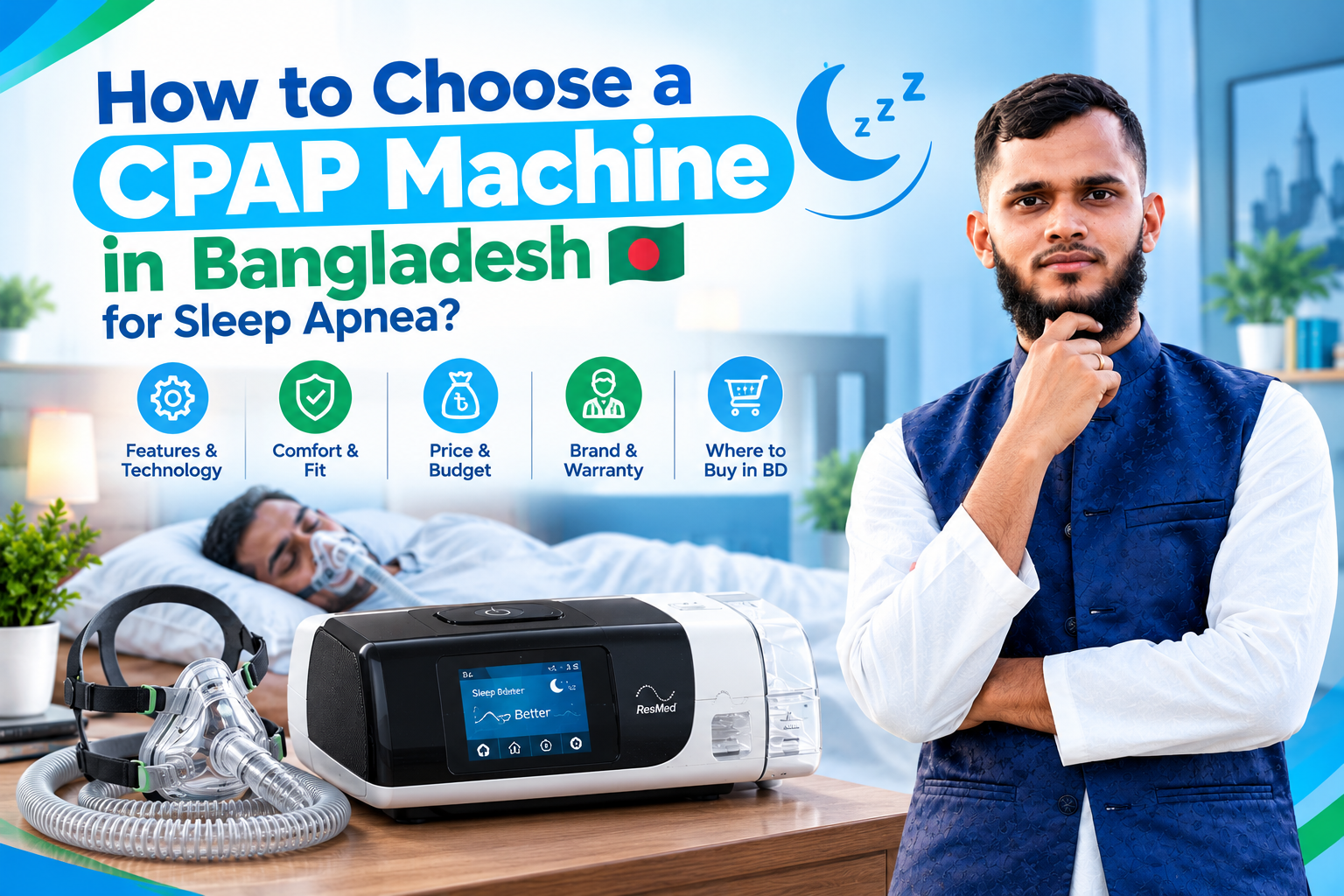
Choosing a CPAP machine for sleep apnea starts with your diagnosis and prescription, not with a features list. The machine’s pressure mode (fixed CPAP, Auto CPAP, or BiPAP) needs to match what a sleep study shows about your breathing pattern. After that, mask type, portability, humidification, and budget narrow down which specific model fits your daily life.
This guide walks through that process in order: understanding what determines your therapy type, then how to match a machine and mask to your prescription and lifestyle, and finally what to check before buying. It does not diagnose sleep apnea or recommend a pressure setting. Those decisions belong to a qualified physician based on proper testing.
Start Here: What Type of Sleep Apnea Do You Have?
The type of sleep apnea a person has affects which therapy is typically prescribed, so this is the real starting point before comparing any machine.
Obstructive sleep apnea (OSA) happens when throat muscles relax, and the airway partially or fully collapses during sleep. It’s the most common form and is typically treated with CPAP or Auto CPAP, which uses air pressure to keep the airway open mechanically.
Central sleep apnea (CSA) happens when the brain temporarily stops sending proper signals to the muscles that control breathing. It’s less common and can require a different type of positive airway pressure therapy, sometimes BiPAP or a more specialized device, depending on the physician’s assessment.
Mixed (complex) sleep apnea involves features of both, and the appropriate therapy is determined case by case.
If you haven’t been formally diagnosed yet, or you’re still working through symptoms, our guide on sleep apnea symptoms, diagnosis, and treatment in Bangladesh explains what the diagnostic process typically looks like, including when a sleep study is recommended.
How Doctors Determine the Right Therapy Type
A physician usually confirms sleep apnea through a sleep study, either an in-lab polysomnography or a home sleep apnea test, depending on what’s available and appropriate for the patient. The study records breathing patterns, oxygen levels, and airway behavior overnight.
Based on the results, the physician determines:
- Whether the case is obstructive, central, or mixed
- The severity (mild, moderate, or severe)
- The appropriate therapy type (CPAP, Auto CPAP, or BiPAP)
- The pressure range needed, sometimes confirmed through a follow-up titration study
This is the information you actually need before shopping for a machine. Buying a machine first and figuring out settings later works against the purpose of the therapy.
Direct answer: No, you should not choose a CPAP machine before getting a proper diagnosis and prescription. The machine needs to match what the sleep study shows, not personal preference or price alone.
CPAP vs Auto CPAP vs BiPAP: Matching the Machine to the Prescription
Once you have a prescription, the therapy type narrows your options considerably.
| Therapy type | How it works | Typically considered for |
|---|---|---|
| Fixed CPAP | Delivers one constant pressure all night | Patients whose optimal pressure has been confirmed and doesn’t vary much |
| Auto CPAP (APAP) | Automatically adjusts pressure within a prescribed range based on breathing | Patients whose pressure needs may vary by position, weight, or night to night |
| BiPAP | Delivers two separate pressure levels: higher for inhaling, lower for exhaling | Patients who need a different pressure approach, sometimes including central sleep apnea or certain complex cases, based on physician assessment |
BiPAP is not simply a more advanced CPAP machine. It’s a distinct form of positive airway pressure therapy used for different clinical situations, and moving from CPAP to BiPAP (or the reverse) should be a decision made by your physician, not a self-directed upgrade.
If you want a closer look at specific Auto CPAP models available in Bangladesh once you know your therapy type, our comparison of the best CPAP machines in Bangladesh breaks down current options by use case and budget.
Step-by-Step: How to Choose a CPAP Machine
1. Confirm your diagnosis and prescription first
Everything else in this list depends on this step. Skipping it means guessing at settings that are meant to be individually determined.
2. Confirm the exact pressure mode and range prescribed
Ask your physician directly whether you need fixed CPAP, Auto CPAP, or BiPAP, and what pressure range applies. Write this down before you start comparing machines.
3. Choose a mask type based on how you breathe and sleep
This is one of the most overlooked steps, and it’s covered in detail below, because the wrong mask type is one of the most common reasons people stop using CPAP therapy.
4. Decide between a home machine, a travel machine, or both
If you rarely leave home, a standard home unit is usually sufficient. If you travel often for work or family reasons, a compact travel CPAP with battery compatibility is worth comparing against carrying a full-size unit.
5. Decide whether humidification matters to you
If you notice dryness in your nose or throat, especially in air-conditioned rooms, a machine with a built-in heated humidifier can make a noticeable difference in comfort.
6. Set a realistic budget range
CPAP machines in Bangladesh span a wide price range depending on brand and features. Our complete CPAP machine price guide breaks down current website-listed prices across models so you can set expectations before comparing specific units.
7. Check warranty coverage and availability of consumables
Masks, tubing, and filters need periodic replacement. Confirm these are available locally for the model you’re considering before buying.
8. Decide between buying and renting
If you’re not yet sure CPAP therapy is the right long-term fit, or you need a machine temporarily, renting can be a practical middle step. Our comparison of renting vs buying medical equipment in Bangladesh explains when each option makes more sense.
9. Compare two or three specific machines, not the entire market
Once you know your therapy type, budget, and mask preference, narrow your options to two or three models and compare them directly rather than browsing an entire category page repeatedly. Visit the CPAP Machine Price in Bangladesh category to see current models side by side.
Choosing the Right CPAP Mask Type: Often More Important Than the Machine
Many people focus entirely on the machine and treat the mask as an afterthought, but mask fit is one of the biggest factors in whether CPAP therapy actually gets used consistently. There are three main types.
Nasal mask: Covers the nose only. Works well for people who breathe through their nose during sleep and generally offers a stable seal for higher pressure settings.
Nasal pillow mask: Small cushions that sit at the nostril opening rather than covering the whole nose. Tends to feel less bulky and works well for people who feel claustrophobic with a larger mask, but it may be less suitable at higher pressures for some users.
Full-face mask: Covers both the nose and mouth. Usually recommended for people who breathe through their mouth during sleep, since a nasal-only mask would let air escape if the mouth opens.
Direct answer: The right mask type depends mainly on whether you breathe through your nose or mouth during sleep, not on which one looks more comfortable in a photo. If you’re not sure which category you fall into, your physician or sleep technician can usually tell from the sleep study itself, since mouth breathing during sleep is often visible in the test.
A mask that doesn’t match your breathing pattern is one of the most common reasons people report discomfort or give up on CPAP therapy early, independent of which machine brand they chose.
Features Worth Comparing Once Your Therapy Type Is Confirmed
After the prescription and mask type are settled, these features are what actually differentiate machines:
- Ramp feature: Gradually increases pressure at the start of the session, which some users find easier for falling asleep.
- Humidification: Built-in heated humidifiers reduce dryness but add to the machine’s cost.
- Data tracking: Some machines log nightly usage through an app or SD card, useful for follow-up visits with your doctor to review how consistently therapy is being used.
- Noise level: Matters more if you share a room. Manufacturers publish decibel figures for some models; ask for this directly if it’s a priority.
- Size and weight: Relevant mainly if you plan to travel with the machine regularly.
None of these features change what the machine fundamentally does. They affect comfort and convenience, not the core therapy itself.
Common Mistakes When Choosing a CPAP Machine for Sleep Apnea
- Buying a machine before getting a proper diagnosis. This is the most consequential mistake, since the wrong pressure mode can make therapy feel ineffective or uncomfortable.
- Choosing a mask based on appearance rather than breathing pattern. A poorly matched mask is a common reason people abandon therapy in the first few weeks.
- Assuming a more expensive machine automatically works better. Price differences often reflect brand, humidification, and connectivity features more than core therapy effectiveness.
- Ignoring ongoing costs. Mask cushions, tubing, and filters need regular replacement and should factor into your budget from the start.
- Not asking about warranty and local parts availability before buying, particularly for less common brands.
- Skipping maintenance planning. Bangladesh’s humidity affects how CPAP equipment should be cleaned and dried; our guide on cleaning and maintaining a CPAP machine in Bangladesh’s climate covers the routine you’ll need once you start using the machine.
When Might a Doctor Recommend BiPAP Instead of CPAP?
BiPAP is generally considered when a patient doesn’t respond well to CPAP, needs a different pressure approach for exhaling comfortably, or has a diagnosis such as central sleep apnea or certain complex breathing patterns where two separate pressure levels are more appropriate. This decision is made by a physician based on your sleep study results and, in some cases, how you respond to an initial CPAP trial. It is not something to decide independently based on comfort preference alone.
How Much Should You Budget for a Sleep Apnea Machine?
CPAP machines in Bangladesh are currently listed at a wide range of prices depending on brand, pressure mode, and features, from entry-level Auto CPAP units to premium models with integrated humidification and connectivity. Rather than repeating that full breakdown here, our CPAP Machine Price in Bangladesh guide covers current website-listed prices in detail, including a full comparison table across brands.
As a general rule, budget for the machine itself plus a mask, tubing, and filters as separate costs, since these are typically sold apart from the main unit.
Frequently Asked Questions
Which CPAP machine is best for sleep apnea?
There isn’t one best machine for everyone. The right choice depends on your prescribed therapy type (fixed CPAP, Auto CPAP, or BiPAP), your mask fit, and your budget. A machine that suits one patient’s obstructive sleep apnea may not suit another’s central sleep apnea or comfort needs.
Can I buy a CPAP machine without a prescription?
CPAP machines are medical devices, and pressure settings should be determined by a physician based on a sleep study. While retail purchase policies can vary by supplier, using a machine without proper medical guidance is not recommended, since incorrect settings reduce the therapy’s effectiveness.
What is the difference between a CPAP machine and a sleep apnea machine?
They generally refer to the same category of device. “Sleep apnea machine” is a common way people search for CPAP equipment, while “CPAP machine” is the more precise clinical term for the continuous positive airway pressure device most commonly used to treat obstructive sleep apnea.
How do I know if I need a full-face mask or a nasal mask?
This usually depends on whether you breathe through your nose or mouth during sleep. Mouth breathers generally need a full-face mask, since a nasal-only mask allows air to escape if the mouth opens. Your physician or sleep technician can often determine this from your sleep study results.
Is Auto CPAP always better than fixed CPAP for sleep apnea?
Not necessarily. Auto CPAP adjusts pressure automatically, which helps when pressure needs vary, but fixed CPAP works well when a stable pressure has already been confirmed through testing. The right option depends on the physician’s assessment, not a general rule that one is always superior.
Can lifestyle changes replace the need for a CPAP machine?
For some patients with mild sleep apnea, weight management, sleep position changes, or reducing alcohol before bed may help reduce symptoms, but this should be discussed with a physician rather than used as a substitute for prescribed therapy without medical guidance, particularly for moderate to severe cases.
How long does it take to get used to a CPAP machine?
This varies by person and is influenced heavily by mask fit and pressure comfort. Many people adjust within a few weeks, though this is a general observation rather than a guaranteed timeline, and difficulty adjusting is worth discussing with your physician rather than assuming it will resolve on its own.
Why Consider Medical Mart BD
Choosing between machine types and specific models is easier once you know what to look for. Medical Mart BD’s CPAP Machine Price in Bangladesh category lists Fixed CPAP, Auto CPAP, and Travel CPAP options from ResMed, BMC, Philips, and ResFree, which makes side-by-side comparison possible once you have your prescription details in hand. Over roughly four years of medical equipment supply and customer support, the business has worked with patients, caregivers, and clinics across Bangladesh, helping them think through mask compatibility, humidification needs, portability, and whether renting or buying fits their situation better. If you have questions about matching a specific machine to your prescription, you can contact Medical Mart BD directly for product-level guidance.
Conclusion
Choosing a CPAP machine for sleep apnea works best in this order: get a proper diagnosis and prescription, confirm the exact therapy type and pressure range, choose a mask that matches how you breathe, then compare machines on portability, humidification, and budget. Skipping the first two steps and starting with brand or price comparisons is the most common mistake people make. Once you know what you actually need, explore CPAP machines available at Medical Mart BD and compare current models, features, and prices before choosing the option that fits your prescription and daily routine.
Author Byline & Expertise
Md Hasibul Islam, Founder, Medical Mart BD
Md Hasibul Islam has spent four years in medical equipment supply and customer support through Medical Mart BD, helping patients, family caregivers, clinics, and healthcare professionals across Bangladesh understand how CPAP, Auto CPAP, and BiPAP machines differ, and how to match equipment choices to a physician’s prescription, mask fit, and daily routine.
In December 2025, he attended two consecutive international conferences focused on sleep disorders and sleep apnoea: the 2nd International Conference of the Nepalese Society of Sleep Disorders (5-6 December 2025, Kathmandu, Nepal) and the 10th International Conference & Live Surgery on Sleep Apnoea, organized by the Association of Surgeons for Sleep Apnoea, Bangladesh (ASSAB), held 13-14 December 2025 at Dhaka Medical College Hospital and Pan Pacific Sonargaon, Dhaka. Both conferences were attended primarily by physicians, surgeons, and sleep medicine specialists. This article reflects business and customer-support experience in medical equipment supply. It is not medical advice, does not diagnose sleep apnea, and does not replace consultation with a qualified physician or sleep specialist.




4 thoughts on “How to Choose a CPAP Machine in Bangladesh for Sleep Apnea?”