Sleep Apnea in Bangladesh: Symptoms, Diagnosis & Treatment Guide

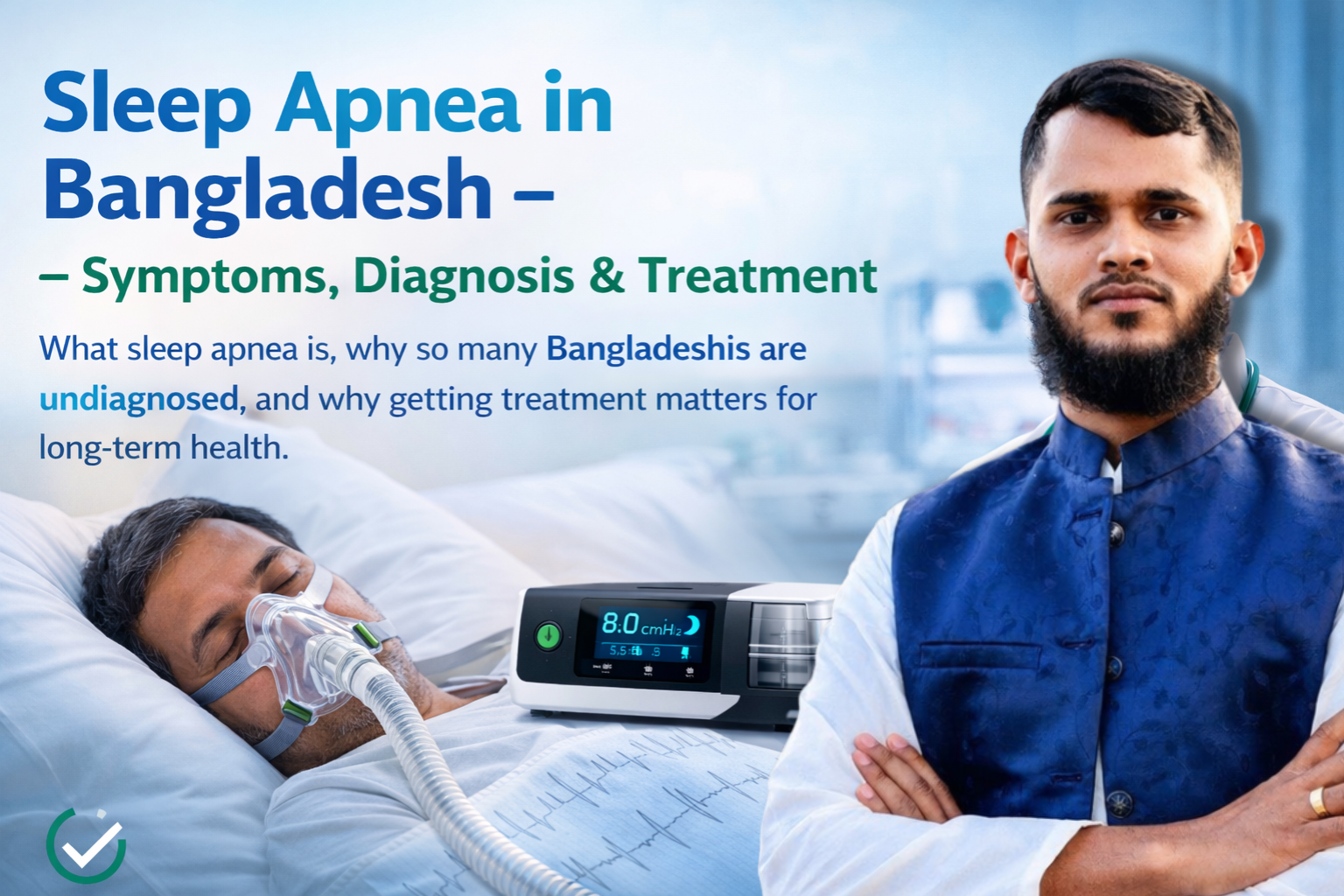
Sleep apnea is a condition where breathing repeatedly stops and starts during sleep, most commonly because the airway partially or fully collapses. The most noticeable signs are loud snoring, choking or gasping during sleep, and feeling tired during the day despite a full night in bed. It’s confirmed through a sleep study, not through symptoms alone, and treatment options range from CPAP therapy to oral appliances and, in some cases, surgery.
This guide explains what sleep apnea is, how it’s typically diagnosed, what the process looks like in Bangladesh specifically, and the treatment options a physician might discuss with you. It is written for general education. It does not diagnose sleep apnea and does not replace an evaluation by a qualified physician or sleep medicine specialist.
What Is Sleep Apnea?
Sleep apnea is a sleep-related breathing disorder in which a person’s breathing repeatedly pauses or becomes shallow during sleep, disrupting normal oxygen flow and sleep quality. These pauses, called apneas, can happen dozens of times an hour in more severe cases, though the person experiencing them is often unaware it’s happening.
There are three recognized types, and they’re not interchangeable:
| Type | What happens | Common association |
|---|---|---|
| Obstructive sleep apnea (OSA) | The throat muscles relax and the airway physically collapses, blocking airflow | The most common form; linked to airway anatomy, weight, and muscle tone |
| Central sleep apnea (CSA) | The brain temporarily fails to send proper signals to the muscles controlling breathing | Less common; can be linked to heart conditions or certain neurological factors |
| Mixed (complex) sleep apnea | Features of both obstructive and central apnea occur in the same person | Identified during a sleep study; treatment approach depends on the specific pattern |
Obstructive sleep apnea is by far the most frequently diagnosed type and is the main focus of most CPAP-based treatment discussions, including the rest of this guide.
How Common Is Sleep Apnea, and How Common Is It in Bangladesh?
A 2019 global analysis published in The Lancet Respiratory Medicine (Benjafield et al.) estimated that approximately 936 million adults aged 30 to 69 worldwide have some degree of obstructive sleep apnea, based on modeled data across multiple countries. This figure reflects a global estimate using population modeling, not a direct headcount, and it is not specific to Bangladesh.
Dedicated, large-scale epidemiological studies measuring sleep apnea prevalence within Bangladesh specifically are limited in publicly available literature. What is reasonably well established is that several known risk factors for OSA, including rising obesity rates and increasing urbanization, are relevant trends in Bangladesh, which is one reason clinical interest in sleep medicine has grown here in recent years. Organizations such as the Association of Surgeons for Sleep Apnoea, Bangladesh (ASSAB) have been active in this space, including hosting international clinical conferences on sleep apnea diagnosis and surgical treatment in Dhaka.
Rather than citing an unverified local statistic, the more useful takeaway is this: sleep apnea is a genuinely common condition worldwide; it is under-diagnosed in many populations because symptoms are often dismissed as ordinary snoring or tiredness, and growing clinical attention in Bangladesh suggests it is more prevalent here than historical diagnosis rates might suggest.
Symptoms of Sleep Apnea
Sleep apnea symptoms typically show up in two categories: what happens during sleep (often noticed by a bed partner or family member) and what happens during the day.
Direct answer: The most reported symptoms of sleep apnea are loud, frequent snoring, episodes of gasping or choking during sleep, and persistent daytime sleepiness even after what seems like a full night’s sleep. Not everyone with sleep apnea snores loudly, and not everyone who snores has sleep apnea, which is why a sleep study is needed to confirm it.
| Nighttime symptoms | Daytime symptoms |
|---|---|
| Loud, chronic snoring | Excessive daytime sleepiness |
| Witnessed pauses in breathing | Difficulty concentrating |
| Gasping or choking during sleep | Morning headaches |
| Restless or interrupted sleep | Irritability or mood changes |
| Frequent nighttime urination | Dry mouth or sore throat on waking |
| Waking up feeling unrefreshed | Falling asleep during quiet daytime activities |
A family member or caregiver often notices the nighttime symptoms before the person with sleep apnea does, since the episodes happen during sleep. If someone in your household has described these signs, that observation is worth bringing up with a physician, even if the person experiencing it feels fine during the day.
Who Is More Likely to Develop Sleep Apnea?
Several factors increase the likelihood of obstructive sleep apnea, though having one or more of these does not confirm a diagnosis:
- Excess body weight, particularly fat distribution around the neck and upper airway
- Larger neck circumference, which can narrow the airway
- Male sex, though OSA is also diagnosed in women, particularly after menopause
- Age, with risk generally increasing in middle age and older adulthood
- Family history of sleep apnea or airway-related conditions
- Smoking and alcohol use, both of which can relax throat muscles or increase airway inflammation
- Nasal congestion or structural airway issues, including enlarged tonsils
- Certain jaw and facial structures, such as a recessed jaw
These are risk factors, not diagnostic criteria. Many people with several risk factors don’t have sleep apnea, and some people with none of these factors do. A sleep study is the only way to confirm it either way.
Why Untreated Sleep Apnea Matters
Sleep apnea repeatedly interrupts normal oxygen flow and sleep architecture, and over time this has been associated with several health risks beyond daytime tiredness. Research in sleep medicine has linked untreated obstructive sleep apnea to a higher risk of high blood pressure, cardiovascular strain, and increased likelihood of accidents caused by daytime drowsiness, including while driving. It has also been studied in connection with metabolic conditions such as type 2 diabetes, though the relationship in each individual case depends on multiple factors beyond sleep apnea alone.
None of this means every case of sleep apnea leads to these outcomes. It means the condition is worth taking seriously enough to get evaluated rather than managing symptoms informally for years.
How Is Sleep Apnea Diagnosed?
Direct answer: Sleep apnea is diagnosed through a sleep study, either an in-lab polysomnography or a home sleep apnea test, which records breathing patterns, oxygen levels, and airway activity overnight. Symptoms alone, including snoring, are not enough to confirm a diagnosis; a physician uses the sleep study results to measure how often breathing is disrupted and how severe the pattern is.
The diagnostic process generally follows these steps:
- Initial consultation. A physician reviews your symptoms, medical history, and risk factors. This may involve a general practitioner, a pulmonologist, an ENT specialist, or a sleep medicine specialist, depending on availability and referral pathway.
- Screening questionnaires. Doctors often use standardized screening tools such as the Epworth Sleepiness Scale (which measures daytime sleepiness) or STOP-BANG (which screens for OSA risk factors) to decide whether a full sleep study is warranted. These are screening tools used to guide next steps, not diagnostic tests on their own.
- Sleep study. This is the confirming step. It can be done as an in-lab polysomnography, where you sleep in a monitored clinical setting connected to sensors, or as a home sleep apnea test, which uses portable equipment to record key data overnight in your own bed.
- Apnea-Hypopnea Index (AHI) calculation. The sleep study generates an AHI score, the average number of breathing disruptions per hour of sleep, which is used to classify severity.
- Diagnosis and severity classification. Based on the AHI and other findings, the physician confirms whether sleep apnea is present and how severe it is.
| AHI Score (events per hour) | General severity classification |
|---|---|
| Below 5 | Not considered sleep apnea |
| 5 to 15 | Mild |
| 15 to 30 | Moderate |
| Above 30 | Severe |
This classification follows criteria commonly used in sleep medicine and is meant to be interpreted by the physician who ordered the study, alongside your symptoms and health history, not applied independently by a patient reading a sleep study printout.
Getting Diagnosed in Bangladesh: What to Expect
If you suspect sleep apnea based on your own symptoms or what a family member has observed, the typical starting point in Bangladesh is a consultation with a general physician, pulmonologist, or ENT specialist, who can assess your symptoms and refer you for a sleep study if warranted. Sleep study services, including polysomnography, are increasingly available through pulmonology and neurology departments at major hospitals and specialized sleep clinics in Dhaka and other large cities, though availability and waiting times can vary by facility.
Growing clinical interest in this field is reflected in recent developments such as the 10th International Conference & Live Surgery on Sleep Apnoea, held in December 2025 at Dhaka Medical College Hospital and organized by the Association of Surgeons for Sleep Apnoea, Bangladesh (ASSAB), with participation from sleep medicine specialists across South Asia and beyond. This kind of ongoing clinical engagement suggests diagnostic and treatment pathways for sleep apnea in Bangladesh are actively developing rather than static.
If cost or access to a full in-lab sleep study is a concern, ask your physician whether a home sleep apnea test is a suitable alternative for your case. It’s generally less expensive and can be done in your own bed, though it isn’t appropriate for every patient, particularly those with certain other health conditions, and that determination should be made by your physician.
Treatment Options for Sleep Apnea
Direct answer: There is no single universal treatment for sleep apnea. The right approach depends on the type and severity diagnosed, and can include CPAP or BiPAP therapy, oral appliances, positional therapy, weight management, or surgery in select cases. Most treatment plans start with the least invasive option that matches the diagnosed severity.
| Treatment | How it works | Typically considered for |
|---|---|---|
| CPAP (Continuous Positive Airway Pressure) | Delivers constant air pressure through a mask to keep the airway open | Most common first-line treatment for moderate to severe OSA |
| Auto CPAP (APAP) | Automatically adjusts pressure within a prescribed range based on breathing | Patients whose pressure needs vary night to night |
| BiPAP (Bilevel Positive Airway Pressure) | Delivers two separate pressure levels for inhaling and exhaling | Certain complex cases, including some central sleep apnea presentations, based on physician assessment |
| Oral appliances (mandibular advancement devices) | Repositions the jaw to help keep the airway open | Mild to moderate OSA, or patients who cannot tolerate CPAP |
| Positional therapy | Devices or techniques that discourage sleeping on the back, which can worsen airway collapse in some patients | Patients whose apnea is significantly worse when sleeping on their back |
| Weight management | Reducing excess weight around the neck and upper airway | Patients where excess weight is a contributing factor, alongside other treatment |
| Surgery | Various procedures depending on the specific anatomical cause, ranging from tonsil removal to airway reconstruction | Cases where anatomical obstruction is identified and other treatments haven’t worked or aren’t suitable |
CPAP therapy is the most widely prescribed first-line treatment because it directly addresses the airway collapse mechanically and works for a broad range of OSA severity levels, from mild to severe. It doesn’t cure sleep apnea; it manages the symptom of airway collapse for as long as it’s used consistently, as recommended by your physician.
CPAP Therapy: What It Involves
If your physician recommends CPAP, the machine delivers pressurized air through a mask worn during sleep, keeping the airway open and preventing the pauses in breathing that define sleep apnea. The specific pressure setting and machine type, fixed CPAP or Auto CPAP, are determined by your physician based on your sleep study results, not by personal preference.
Choosing the right machine and mask involves several practical factors beyond the medical prescription, including mask type, portability, humidification, and budget. Our guide on how to choose a CPAP machine for sleep apnea walks through this decision process in detail once your prescription is confirmed. If you’re ready to compare specific machines and current prices, the CPAP machine price in Bangladesh guide and the best CPAP machines in Bangladesh comparison cover current models by brand and use case. For a closer look at how the major brands available in Bangladesh compare, see our breakdown of ResMed vs Philips vs BMC CPAP machines.
CPAP equipment also needs regular cleaning, particularly given Bangladesh’s humidity and dust conditions. Our guide on cleaning and maintaining a CPAP machine in Bangladesh’s climate covers the daily and weekly routine needed to keep the equipment hygienic and functioning properly.
Buying vs Renting CPAP Equipment During Diagnosis and Early Treatment
If you’ve just been diagnosed and aren’t yet sure CPAP therapy is the right long-term fit, or your physician wants to monitor how you respond to therapy before committing to a purchase, renting equipment can be a practical first step. This avoids a large upfront cost before you know whether the prescribed pressure and mask type work well for you. Our comparison of renting vs buying medical equipment in Bangladesh explains when each option makes sense, and Medical Mart BD’s CPAP and BiPAP rental service in Dhaka is one option worth discussing with your physician if a trial period fits your situation.
Common Myths About Sleep Apnea
- “Only overweight people get sleep apnea.” Excess weight is a risk factor, not a requirement. People with normal body weight can have OSA due to airway anatomy, and thin individuals are sometimes underdiagnosed because clinicians don’t suspect it.
- “If I don’t snore, I don’t have sleep apnea.” Snoring is a common symptom but not universal. Some people with sleep apnea, particularly central sleep apnea, may not snore loudly or at all.
- “CPAP is a permanent, lifelong dependency with no alternatives.” CPAP is the most common first-line treatment, but oral appliances, positional therapy, weight management, and surgery are all recognized options depending on the diagnosis. The right treatment is a discussion with your physician, not a fixed outcome.
- “Sleep apnea is just loud snoring and isn’t a serious health issue.” Sleep apnea has been linked in research to increased cardiovascular strain and daytime accident risk when left untreated, which is why a proper diagnosis matters even if the daytime symptoms feel manageable.
When Should You See a Doctor?
Direct answer: See a physician if you or someone in your household has noticed loud snoring combined with witnessed pauses in breathing, gasping or choking during sleep, or persistent daytime sleepiness that isn’t explained by an obvious cause like poor sleep schedule. These combined patterns, rather than any single symptom alone, are what typically prompt a referral for a sleep study.
If you’re unsure whether your symptoms warrant an evaluation, a general physician can make that judgment during a routine consultation and refer you onward if needed. Waiting for symptoms to become severe before seeking evaluation generally isn’t necessary and can mean living with poor sleep quality and its downstream effects for longer than needed.
Frequently Asked Questions
Can sleep apnea be cured?
It depends on the cause and severity. Some cases, particularly those linked to a specific anatomical issue or excess weight, can improve significantly or resolve with targeted treatment such as surgery or substantial weight loss. Others, particularly more severe or structurally driven cases, are managed long-term with CPAP or other therapy rather than cured outright. This determination should come from your physician based on your specific diagnosis.
Is sleep apnea dangerous if left untreated?
Untreated sleep apnea has been associated in sleep medicine research with increased risk of high blood pressure, cardiovascular strain, and accidents related to daytime sleepiness. The degree of risk varies by individual and severity, which is part of why a proper diagnosis and follow-up with a physician matter.
Can children have sleep apnea?
Yes. Sleep apnea in children is often linked to enlarged tonsils or adenoids and can present differently than in adults, sometimes showing up as behavioral issues or hyperactivity rather than obvious daytime sleepiness. If you suspect a child has sleep apnea symptoms, a pediatrician or ENT specialist should evaluate them directly.
Does losing weight cure sleep apnea?
For some patients where excess weight is a significant contributing factor, weight loss can meaningfully reduce the severity of obstructive sleep apnea, and in some cases reduce or eliminate the need for other treatment. It doesn’t work the same way for every patient, since airway anatomy and other factors also play a role, so it’s generally recommended alongside, not instead of, medical follow-up.
Is snoring always a sign of sleep apnea?
No. Snoring is common and doesn’t always indicate sleep apnea. What tends to raise concern is snoring combined with witnessed breathing pauses, gasping, or choking during sleep, along with daytime symptoms like persistent tiredness. A sleep study is the only way to confirm whether snoring is linked to sleep apnea in a specific case.
How long does a sleep study take?
An in-lab polysomnography typically involves one overnight stay at a sleep clinic or hospital, while a home sleep apnea test is done over one or more nights in your own bed using portable equipment. Results are usually reviewed and discussed with your physician at a follow-up appointment rather than immediately after the study.
Buying Support and Practical Resources
If you’ve been diagnosed and are moving toward treatment, a few practical resources are worth knowing about. Medical Mart BD’s about page outlines the business’s background in medical equipment supply, and the BiPAP and CPAP equipment range covers both therapy types in one place. For logistics and policies, the shipping policy, support policy, return and refund policy, terms and conditions, and privacy policy explain what to expect when ordering. You can also browse the full shop or the blog for more guides, or contact Medical Mart BD directly with questions about equipment options once your physician has confirmed a treatment plan.
Why Consider Medical Mart BD
Getting a sleep apnea diagnosis is the medical part of this process, handled by your physician and a sleep study. Once treatment involves CPAP or BiPAP equipment, Medical Mart BD, one of the medical equipment suppliers in Bangladesh, lists machines from ResMed, Philips, BMC, and ResFree on its CPAP machine category page, along with a rental option for patients who want to trial therapy before purchasing. Over roughly four years of medical equipment supply and customer support, the business has worked with patients, caregivers, and clinics across Bangladesh, helping them understand equipment choices once a physician has confirmed their treatment plan. This guide, and the equipment-focused guides linked throughout it, reflect that practical experience, not clinical expertise.
Conclusion
Sleep apnea is a common but frequently under-recognized condition, and the path from suspecting it to treating it runs through a proper diagnosis, not through guessing based on symptoms or self-testing at home. If the symptoms described here sound familiar, whether in yourself or someone you care for, the next step is a conversation with a physician, followed by a sleep study if warranted. Once a diagnosis and treatment plan are in place, and if CPAP therapy is part of that plan, you can explore CPAP machines available at Medical Mart BD and compare current models, features, and prices before choosing the option that fits your prescription and daily routine.
Author Byline & Expertise
Md Hasibul Islam, Founder, Medical Mart BD
Md Hasibul Islam has spent four years in medical equipment supply and customer support through Medical Mart BD, working with patients, family caregivers, clinics, and healthcare professionals across Bangladesh on equipment selection for CPAP and BiPAP therapy once a diagnosis and treatment plan are in place.
In December 2025, he attended two consecutive international conferences focused on sleep disorders and sleep apnoea: the 2nd International Conference of the Nepalese Society of Sleep Disorders (5-6 December 2025, Kathmandu, Nepal) and the 10th International Conference & Live Surgery on Sleep Apnoea, organized by the Association of Surgeons for Sleep Apnoea, Bangladesh (ASSAB), held 13-14 December 2025 at Dhaka Medical College Hospital and Pan Pacific Sonargaon, Dhaka. Both conferences were attended primarily by physicians, surgeons, and sleep medicine specialists. This article reflects general medical information compiled from established sleep medicine sources and business experience in medical equipment supply. It is not medical advice, does not diagnose sleep apnea, and does not replace consultation with a qualified physician or sleep medicine specialist.