How Do You Choose the Right Travel CPAP Machine?
The right travel CPAP depends mainly on four factors: size and weight, humidification type, power flexibility, and mask compatibility. Start by confirming your prescribed pressure settings with your doctor, then compare how each portable model handles the trade-off between ultra-compactness and comfort features like heated humidification. In Bangladesh, travel CPAP machines currently range from around ৳80,000 to ৳1,80,000 depending on brand and features.
A travel CPAP is simply a CPAP machine shrunk down for life on the move — same therapy, a fraction of the size. This guide explains what travel CPAP machines are, how they differ from full-size home units, what to check before buying one in Bangladesh, and what you can realistically expect to pay.
Quick Buying Summary
Frequent international flyer → ResMed AirMini: the smallest option at ~300g, FAA-compliant for in-flight use, waterless humidification, app control. Premium price band.
Budget-conscious traveller → BMC M1 Mini: ultra-compact auto CPAP (~400g) with waterless humidification and Bluetooth app, at roughly half the price of premium models.
Needs battery backup for load-shedding or camping → Breas Z1/Z2 Auto: compact travel CPAPs designed with optional battery packs for off-grid use.
First-time buyer on a budget → Consider whether you need a dedicated travel unit at all — a standard auto CPAP plus a good travel case may serve occasional trips. Read our Auto CPAP vs Travel CPAP comparison before deciding.
What Is a Travel CPAP Machine?
A travel CPAP (also called portable CPAP or mini CPAP) is a continuous positive airway pressure device engineered for portability. It treats the same condition as a full-size CPAP — obstructive sleep apnea — by keeping your airway open with pressurised air while you sleep. The difference is purely physical: where a home CPAP sits on your nightstand with a water chamber and heated tube, a travel CPAP strips the design down to the essentials, typically weighing 300–500 grams and fitting in the palm of your hand.
The entity relationship is simple: Sleep Apnea Treatment → PAP Therapy → CPAP Machine Type → Travel/Portable Variant → Feature Set → Traveller Profile. Travel CPAPs are almost always auto-adjusting (APAP) machines, meaning they automatically tune pressure through the night rather than delivering one fixed pressure.
Who needs one? Anyone with diagnosed sleep apnea who travels regularly — business trips, family visits, Hajj/Umrah pilgrimages, or even frequent load-shedding at home in Bangladesh where a battery-powered unit keeps therapy going when the grid doesn’t.
Types of Travel CPAP Machines
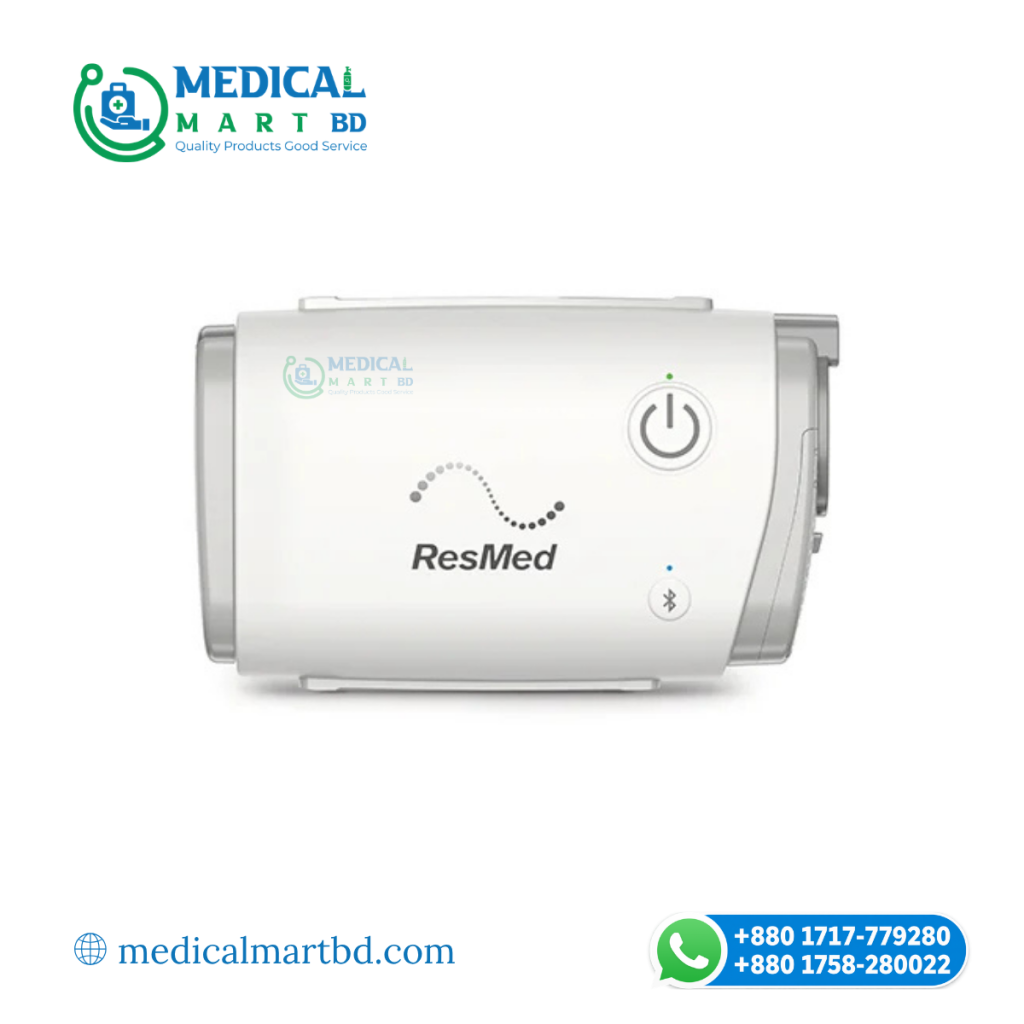
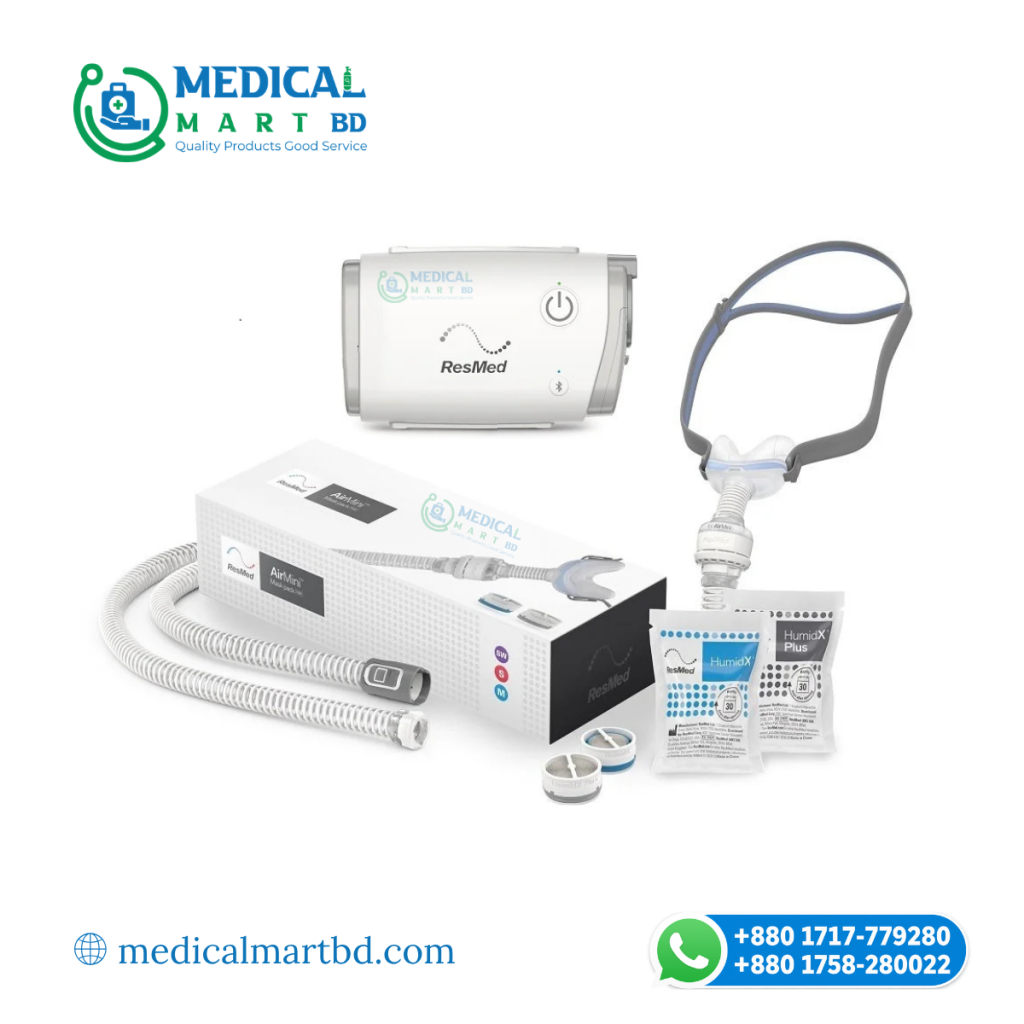
Ultra-Compact Auto CPAP (e.g. ResMed AirMini)
What it is: the smallest class of travel CPAP, roughly the size of a soda can (~300g).
Best for: frequent flyers and minimalists who want the lightest possible kit.
Main advantages: smallest footprint of any CPAP; FAA-compliant for in-flight use; waterless humidification (HumidX) so no distilled water to carry; smartphone app control with sleep data.
Potential disadvantages: premium pricing; works only with specific masks (manufacturer’s own mask range); no integrated heated humidifier; slim tubing sold separately in some packages.
Who should consider it: travellers who fly often and want therapy that fits in a laptop bag.
Compact Auto CPAP with Waterless Humidification (e.g. BMC M1 Mini)
What it is: a palm-sized auto CPAP (~400g) offering automatic pressure adjustment with heat-moisture-exchange (HME) humidification.
Best for: budget-conscious travellers who still want automatic therapy.
Main advantages: significantly lower price than premium travel models; auto-adjusting pressure; Bluetooth app; universal 100–240V power supply suits international travel.
Potential disadvantages: fewer premium comfort features than flagship models; smaller brand service network than ResMed/Philips in some markets.
Who should consider it: first-time travel CPAP buyers in Bangladesh who want proven portable therapy without the premium price tag.
Travel CPAP with Battery Options (e.g. Breas Z1/Z2 Auto)
What it is: compact travel CPAPs designed around optional external battery packs.
Best for: campers, remote-area travellers, and anyone who needs therapy during power cuts.
Main advantages: battery compatibility for off-grid use; compact and quiet; auto-adjusting pressure.
Potential disadvantages: battery packs add cost and weight; total package approaches mid-range pricing once accessories are added.
Who should consider it: travellers who regularly sleep where wall power isn’t guaranteed — including load-shedding-prone areas of Bangladesh.
Key Buying Factors: What to Check Before You Buy
Size and Weight
Why it matters: the whole point of a travel CPAP is portability — every 100 grams counts when it’s in your carry-on. What to look for: under 500g including power supply; dimensions that fit a small pouch. The AirMini (~300g) and BMC M1 Mini (~400g) set the benchmark. Who needs it: anyone flying with only cabin baggage.
Pressure Modes
Why it matters: your machine must deliver the therapy your doctor prescribed. What to look for: auto-adjusting (APAP) mode covers most prescriptions; check the pressure range (typically 4–20 cm H2O) matches your prescription. Who needs it: everyone — never buy a CPAP without a prescription and sleep study.
Humidification
Why it matters: dry pressurised air causes nasal dryness and discomfort, especially in air-conditioned hotel rooms. What to look for: waterless systems (HumidX/HME cartridges) are ideal for travel — no water to carry or spill. Know that cartridges are consumables with recurring cost. Who needs it: travellers to dry climates or anyone prone to nasal dryness.
Power Flexibility and Battery Options
Why it matters: Bangladesh’s load-shedding and international voltage differences can interrupt therapy. What to look for: universal 100–240V power supply (standard on most travel CPAPs); optional manufacturer-approved battery packs for off-grid use; DC/car adapters for road trips. Who needs it: frequent travellers, campers, and anyone in areas with unstable power.
Noise Level
Why it matters: you’ll use it in hotel rooms and possibly on planes, close to other people. What to look for: around 30 dB or lower (comparable to a whisper). Most modern travel CPAPs meet this. Who needs it: light sleepers and anyone sharing rooms while travelling.
Mask Compatibility
Why it matters: some ultra-compact models only work with the manufacturer’s own masks. What to look for: check exactly which masks are supported before buying — the AirMini, for example, works with ResMed’s AirFit/AirTouch mask range. If you already own a mask you love, confirm compatibility. Who needs it: existing CPAP users buying a second, travel-only unit.
Data Tracking and App Control
Why it matters: many travel CPAPs have minimal on-device screens; the app becomes your display. What to look for: Bluetooth app with therapy data, leak reporting, and pressure adjustment (clinician-guided). Who needs it: data-driven users and anyone whose doctor monitors compliance remotely.
FAA Compliance and Airline Rules
Why it matters: if you plan to use the machine during flights, it must be approved for in-flight use. What to look for: FAA-compliant labelling; carry it as medical equipment (airlines generally don’t count CPAPs against carry-on limits); carry your prescription; contact the airline in advance for in-flight use. Who needs it: long-haul travellers, especially on Dhaka–Middle East/Europe routes.
Warranty and After-Sales Support in Bangladesh
Why it matters: a travel CPAP is a precision medical device — local service matters more than a slightly lower import price. What to look for: authorised local warranty, availability of filters/masks/cartridges locally, setup guidance and mask-fitting support. Who needs it: every buyer in Bangladesh.
Travel CPAP Comparison at a Glance
| Option |
Best For |
Key Advantage |
Limitation |
Important Consideration |
| ResMed AirMini |
Frequent flyers |
Smallest (~300g), FAA-compliant, app-controlled |
Premium price; limited mask compatibility |
Verify the package includes the mask setup you need |
| BMC M1 Mini |
Budget travellers |
Auto-adjusting portable therapy at ~half the premium price |
Fewer premium comfort features |
Confirm local warranty and accessory availability |
| Breas Z1/Z2 Auto |
Off-grid use |
Optional battery packs; compact and quiet |
Battery adds cost and weight |
Total cost rises with the battery kit |
| Standard Auto CPAP + travel case |
Occasional travellers |
One machine for home and travel; full humidification |
Bulkier; no battery option |
Often the most economical choice for 2–3 trips a year |
Choose by Use Case
Best for frequent international travel: An ultra-compact model like the ResMed AirMini — it disappears into cabin baggage and is cleared for in-flight use.
Best for Hajj, Umrah, or group tours: A compact auto CPAP with waterless humidification (e.g. BMC M1 Mini) — light, simple, and no distilled water to hunt for.
Best for load-shedding backup at home: A travel CPAP with battery-pack compatibility (e.g. Breas Z1/Z2) doubles as your power-cut therapy solution.
Best for business travellers: Any sub-500g auto CPAP with app control — set it up in minutes in any hotel room.
Best for budget buyers: The BMC M1 Mini class (~৳80,000) delivers genuine portable APAP therapy at the lowest entry price in Bangladesh.
Travel CPAP Machine Price in Bangladesh (2026)
Based on market research across Bangladeshi medical equipment retailers in October 2026, travel CPAP prices in Bangladesh fall into three bands. Prices vary by retailer, package contents (mask type, spare filters, warranty length), and promotions — always confirm current pricing before buying.
Budget range — around ৳75,000 to ৳95,000: This is BMC M1 Mini territory (listed around ৳79,500–৳80,000 by Bangladeshi sellers). Expect a compact auto-adjusting machine with waterless humidification and app control, but fewer premium extras.
Mid range — around ৳1,00,000 to ৳1,40,000: Covers models like the Philips DreamStation Go (listed around ৳1,00,000–৳1,40,000) and the Breas Z2 Auto (listed around ৳1,20,000). You gain brand pedigree, wider accessory ecosystems, and in some cases battery options.
Premium range — around ৳1,40,000 to ৳1,80,000: The ResMed AirMini sits here (Bangladeshi retailers list it between roughly ৳1,20,000 and ৳1,80,000 depending on package). You pay for the smallest form factor, FAA in-flight clearance, and ResMed’s therapy algorithms.
What actually influences the price: brand, included mask and accessories, humidification system, battery compatibility, warranty length, and whether you buy from an authorised local supplier (recommended — grey imports may lack warranty support). For exact current pricing on specific models, contact Medical Mart BD — as one of the established medical equipment suppliers in bangladesh, they can quote genuine, warranty-backed units.
Common Buying Mistakes
Buying a travel CPAP as your first and only machine without medical guidance. Why it’s a problem: travel units compromise on humidification and screen feedback; a full-size auto CPAP is usually the better primary device. Better decision: get your diagnosis, prescription, and primary machine first; add a travel unit if your lifestyle demands it.
Ignoring mask compatibility. Why it’s a problem: ultra-compact models may not work with your existing mask, forcing an unexpected extra purchase. Better decision: check the supported mask list before paying.
Choosing only by price. Why it’s a problem: the cheapest portable unit may lack the pressure range or features your prescription requires. Better decision: match the machine to your prescription first, then compare prices within suitable models.
Forgetting the total cost of ownership. Why it’s a problem: waterless humidification cartridges, replacement filters, slim tubing, and battery packs are recurring or add-on costs. Better decision: ask for the full package price including one year’s consumables.
Skipping the sleep study. Why it’s a problem: without a proper diagnosis and titration, even the best travel CPAP may deliver the wrong pressure. Better decision: complete a sleep study (e.g. at NIDCH or a sleep clinic) and buy on prescription.
Practical Tips for Travel CPAP Buyers
A few things worth knowing before you buy, drawn from how these machines are actually used:
- Always carry it on, never check it in. Airlines treat CPAPs as medical devices, and a lost checked bag means nights without therapy.
- Pack a universal adapter and an extension cord. Hotel bedside outlets are never where you expect them, and Bangladesh’s plug types differ from many destinations.
- If you use waterless humidification, stock cartridges before a long trip. They’re small, but they’re not sold everywhere.
- Test the machine at home for a few nights before travelling. Sorting out mask fit and app pairing in a hotel room is miserable.
- For in-flight use, notify the airline in advance and carry your prescription — most airlines accommodate CPAP use with prior notice.
For independent expert testing perspectives, Sleep Foundation’s expert-tested CPAP machine guide names the ResMed AirMini as its top travel pick, and the NHS hospital guide to travelling with sleep apnoea is a useful pre-flight checklist.
Frequently Asked Questions
Can I use a travel CPAP as my main home machine?
You can, but most sleep physicians recommend a full-size auto CPAP as the primary device — it offers heated humidification, a full display, and quieter operation. A travel CPAP shines as a second unit or for frequent travellers. If you only want one machine and travel occasionally, compare both options in our Auto CPAP vs Travel CPAP guide.
Are travel CPAP machines allowed on airplanes?
Yes. CPAP machines are recognised as medical devices and generally don’t count against carry-on limits. The ResMed AirMini is FAA-compliant for in-flight use. Carry your prescription and inform the airline beforehand if you plan to use it during the flight.
Do travel CPAP machines need distilled water?
Most don’t. Ultra-compact models use waterless humidification (HumidX/HME cartridges) instead of a water chamber — one of their biggest travel advantages. The trade-off is the ongoing cost of replacement cartridges.
How long does a travel CPAP battery last?
It depends on the battery capacity and your pressure settings, but a typical manufacturer-approved battery powers a travel CPAP for one to two nights. Always use the battery designed for your specific model — third-party power banks may not deliver stable output.
Is a travel CPAP as effective as a regular CPAP?
Yes, provided it’s set to your prescribed pressure. Travel CPAPs use the same core therapy (most are auto-adjusting). The differences are comfort features and form factor, not therapeutic effectiveness.
What is the cheapest travel CPAP machine price in Bangladesh?
Based on October 2026 market listings, the BMC M1 Mini is the most affordable portable option at around ৳79,500–৳80,000 from Bangladeshi sellers. Premium models like the ResMed AirMini range from roughly ৳1,40,000 to ৳1,80,000.
Do I need a prescription to buy a travel CPAP in Bangladesh?
A prescription isn’t always enforced at purchase, but you should never start CPAP therapy without one. Get a sleep study done and buy the pressure settings your doctor recommends — using the wrong pressure can be ineffective or harmful.
Where to Buy a Travel CPAP in Bangladesh
Buy from an authorised local supplier so you get a genuine device with valid warranty, setup guidance, and locally available consumables. Medical Mart BD — a trusted name for Sleep Apnea & Respiratory Care Solutions in Bangladesh — stocks portable CPAP options including the ResMed AirMini and BMC M1 Mini, with nationwide delivery, bKash/Nagad/COD payment options, and post-purchase support from their Dhaka showroom.
Next step: browse the travel CPAP collection to compare current models, or explore the full CPAP machine range and CPAP & BiPAP range if you’re still deciding between a travel unit and a home machine.